
Breast augmentation enhances the size and shape of the breasts, restoring balance and improving overall body proportions. It is commonly performed to correct volume loss after pregnancy, address natural asymmetry, or achieve a more harmonious silhouette.
Dr. Ben Naceur Radhi offers personalized augmentation techniques using either implants or autologous fat transfer, depending on each patient’s anatomy and desired result. His approach focuses on achieving natural, long-lasting outcomes while respecting individual proportions.
Ideal candidates are in good general health, with fully developed breasts and realistic expectations. The treatment plan is tailored to each patient, considering skin quality, existing volume, and aesthetic goals.
Performed under local anesthesia with sedation or general anesthesia, the procedure typically lasts one to two hours. Recovery is relatively quick, with progressive settling of the breasts over the following weeks and final results visible within a few months.

Breasts occupy a central place in femininity and self-image. Hypotrophy, post-pregnancy volume loss, or asymmetry create aesthetic and psychological discomfort. Breast augmentation in Tunisia offers a personalized solution through implants or autologous fat. Dr Ben Naceur Radhi masters augmentation techniques ensuring natural, lasting results.
Motivations are both aesthetic and reconstructive. Some women present constitutional hypoplasia. Others notice post-breastfeeding involution or significant asymmetry.
• Constitutional or acquired breast hypotrophy
• Post-pregnancy or post-weight loss volume loss
• Major breast asymmetry exceeding one cup size
• Unilateral hypoplasia (e.g., Poland syndrome)
• Desire for restoration after prophylactic mastectomy
The ideal candidate presents good general health and realistic expectations. Breast development must be complete. Typical age ranges from eighteen to forty-five years.
• Breast development completed for more than one year
• Absence of active breast pathology requiring investigation
• Sufficiently elastic skin to accept the desired volume
• Understanding that an implant is not eternal
• Personal motivation without external pressure
Dr Ben Naceur Radhi evaluates skin quality, existing glandular volume, and symmetry. These elements determine the technique and implant choice.
Evaluation lasts sixty minutes. Dr Ben Naceur Radhi analyzes the bust globally to plan harmonious augmentation.
• Current volume and desired volume, assessed by sizer trial
• Skin elastic quality and glandular parenchyma
• Position of the nipple-areola complex
• Inter-breast symmetry
• Possible indication for associated ptosis correction
Standardized photographs are taken. A trial with external prostheses allows the patient to appreciate the potential result. The operative plan defines the approach, implant position, and volume.
Dr Ben Naceur Radhi performs the intervention, typically as an outpatient, under local anesthesia with sedation or light general anesthesia.
• Approach: Sub-mammary, areolar, or axillary, chosen according to anatomy
• Position: Sub-glandular, sub-muscular, or dual plane
• Implant: Anatomical or round, textured or smooth, chosen custom
• Insertion: Through the incision with a load protector
• Closure: Layered with resorbable sutures
• Harvesting: Liposuction of donor zones
• Preparation: Centrifugation of adipose tissue
• Injection: Micro-injections in the sub-cutaneous and sub-glandular planes
• Indication: Moderate augmentation or as a complement to an implant
Local anesthesia with sedation is preferred for intraoperative monitoring. General anesthesia is reserved for associations with other procedures. Duration is sixty to ninety minutes.
The sub-mammary incision is perfectly hidden in the mammary fold. The areolar approach camouflages the scar at the pigmented junction. The axillary approach leaves an imperceptible mark in the axillary fold. Social discretion is immediate, as a support bra conceals the result during the healing phase.
Breast augmentation carries specific risks.
• Hematoma requiring rapid evacuation
• Prosthesis infection, sometimes requiring removal
• Capsular contracture from fibrous reaction around the implant
• Rupture or leak, requiring replacement
• Displacement or rotation of an anatomical implant
• Residual asymmetry despite control measures
• Wound dehiscence or rare skin necrosis
• Visibility or palpability of the prosthesis edge
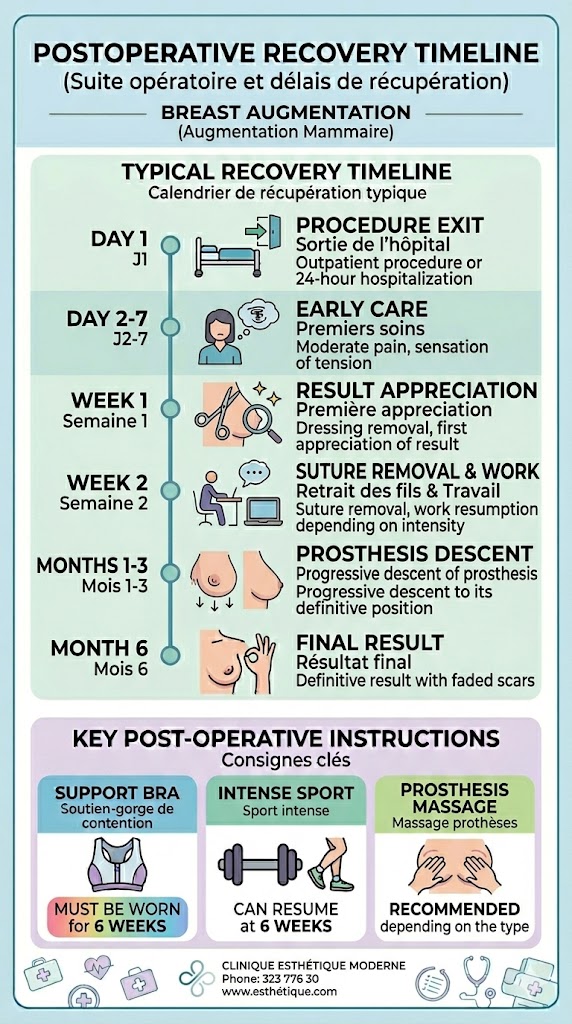
Outpatient procedure or twenty-four hour hospitalization
Moderate pain, sensation of tension
Dressing removal, first appreciation of result
Suture removal, work resumption depending on intensity
Progressive descent of the prosthesis to its definitive position
Definitive result with faded scars
Breast augmentation offers immediate, lasting results. The volume is stable from placement. Psychological adaptation to the new bust takes several months. Patients report improved self-image and confidence.
Dr Ben Naceur Radhi has developed specific expertise in aesthetic breast surgery. His training in modern techniques allows him to achieve harmonious, secure results.
• Mastery of different access routes and prosthesis positions
• Personalized implant choice according to individual anatomy
• A conservative approach prioritizing durability
• Attentive postoperative follow-up and a breast surveillance program
Breast augmentation in Tunisia is a major aesthetic breast surgery offering transformative results. Dr Ben Naceur Radhi proposes personalized techniques combining security and harmony. Patients regain a proportionate bust aligned with their femininity.
Discomfort is moderate in the first days, dominated by a sensation of thoracic tension. Prescribed analgesics ensure sufficient comfort.
Return is possible at five to ten days for sedentary activities. Physical employment may require three weeks.
The sub-mammary scar is invisible in the natural fold. The trans-axillary approach leaves no visible trace.
Yes, when the volume respects body proportions and the prosthesis position is adapted. The preoperative trial allows the patient to appreciate the potential result.
Results typically last ten to fifteen years. A prosthesis may require changing in case of rupture, major capsular contracture, or a desire to change volume.
Yes, most patients can. The sub-muscular position preserves the gland. An areolar approach may alter some galactophore ducts.
No, modern prostheses do not increase breast cancer risk. Regular breast surveillance remains necessary.
A procedure to rebuild the breast after mastectomy or trauma, restoring body contour.

A procedure to reduce breast volume, improving physical comfort and body balance.

Surgery to correct sagging breasts and restore their position and firmness.
We place experience, medical rigor, and technical precision at the service of safe and personalized care.

