

Breast reconstruction rebuilds the breast following mastectomy or trauma, restoring body contour and helping patients regain confidence and a sense of wholeness. It can be performed immediately or delayed, depending on the oncological treatment plan.
Dr. Ben Naceur Radhi offers both implant-based and autologous reconstruction techniques, tailored to each patient’s anatomy and medical history. A multidisciplinary approach ensures safe, personalized care throughout the process.
There are many different types of cardiomyopathy caused by a range of factors, from coronary heart disease to certain drugs. These can all lead to an irregular heartbeat, heart failure, a heart valve problem, or other complications.
If you have known coronary artery disease, your doctor might recommend the traditional approach because you can also receive treatment during the procedure. Your doctor should give you instructions about how to prepare for CT.

Mastectomy for breast cancer constitutes a major physical and psychological ordeal. Breast reconstruction in Tunisia proposes restoring bodily integrity and self-image. Dr Ben Naceur Radhi masters immediate or delayed reconstruction techniques, by implants or autologous flaps, ensuring comprehensive, compassionate care.
Motivations are mainly psychological and functional. Completing the silhouette’s integrity helps finalize the oncological treatment.
• Immediate reconstruction during a skin-sparing mastectomy
• Delayed reconstruction after completed oncological treatment
• Reconstruction after prophylactic genetic mastectomy
• Post-radical or post-traumatic asymmetry correction
• Partial reconstruction after an extensive tumorectomy
The ideal candidate presents good general health and strong motivation. Oncological treatment may be terminated or ongoing, depending on the chosen strategy.
• Absence of contraindication to general anesthesia
• Thoracic skin state compatible with the chosen technique
• Understanding that reconstruction occurs in several stages
• Acceptance of additional scars depending on the technique
• Adequate psychological support during the journey
Dr Ben Naceur Radhi collaborates closely with oncologists and senologists. The reconstruction decision is made in a multidisciplinary consultation meeting.
Evaluation lasts sixty to eighty minutes. Dr Ben Naceur Radhi analyzes the situation globally to plan an adapted reconstruction.
• State of the thoracic skin and quality of residual soft tissue
• Presence or absence of the great dorsal muscle for a flap
• Potential autologous donor zones (abdomen, back, thighs)
• Symmetry with the contralateral breast
• Patient desires and expectations
Standardized photographs are taken. The therapeutic plan defines the technique, timing, and successive stages.
Dr Ben Naceur Radhi adapts the technique to the indication and patient preferences.
• Tissue expansion: Placement of a sub-muscular expander
• Progressive fillings: Outpatient visits every two weeks
• Replacement: Exchange for a definitive prosthesis after complete expansion
• Indication: Immediate reconstruction or when skin quality is sufficient
• Great dorsal flap: Dorsal musculo-cutaneous flap, with or without a prosthesis
• DIEP or TRAM flap: Free or pedicled abdominal flap
• Indication: Reconstruction without a prosthesis, especially for irradiated skin
• Tattooing: Areola reconstruction by dermopigmentation
• Surgical reconstruction: Using local skin flaps or grafts
General anesthesia is systematic. Duration varies from two to eight hours, depending on the complexity and technique.
Scars depend on the technique. Prosthesis reconstruction limits marks to the breast incision. Flap reconstruction adds donor site scars. Nipple reconstruction completes the natural appearance. Social discretion progresses with the stages. The final result emerges after six to twelve months.
Breast reconstruction carries specific risks linked to the complexity of the techniques.
• Hematoma or seroma requiring drainage
• Expander or prosthesis infection, potentially requiring removal
• Partial or total flap necrosis
• Anastomotic vascular insufficiency for free flaps
• Hernia or dehiscence at the abdominal donor site
• Major asymmetry with the contralateral breast
• Hypertrophic or retractile scars
• Insufficient result requiring revision surgery
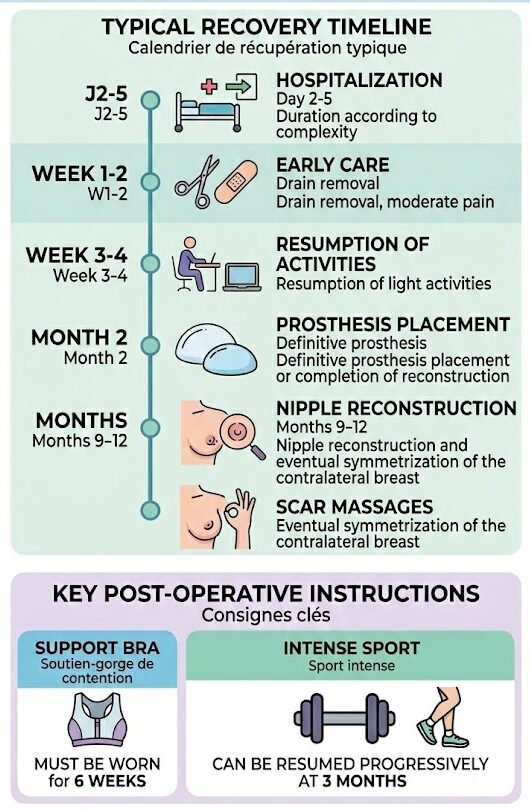
Hospitalization according to complexity
Drain removal, moderate pain
Resumption of light activities
Definitive prosthesis placement or completion of reconstruction
Nipple reconstruction and eventual symmetrization of the contralateral breast
Breast reconstruction offers major functional and psychological results. Bodily integrity is restored, and self-image is significantly improved. Patients report better body acceptance after cancer. Reconstruction completes the oncological treatment journey.
Dr Ben Naceur Radhi has developed significant expertise in breast reconstructive surgery. His microsurgical training allows him to offer all reconstruction options.
• Close collaboration with the oncological team
• Mastery of both prosthetic and autologous techniques
• A compassionate, individualized approach
• Rigorous management of specific complications
Breast reconstruction in Tunisia is an essential step in breast cancer management for many women. Dr Ben Naceur Radhi proposes modern techniques combining oncological security and aesthetic results. Patients can regain their bodily integrity and a sense of femininity.
Discomfort is moderate to significant, depending on the technique. Abdominal flaps are generally more painful than prosthesis reconstruction.
Either immediately during the mastectomy, if the indication allows, or delayed after the completion of treatment. Timing depends on the oncological strategy.
No. Clinical and radiological surveillance remains possible. Self-palpation is more difficult, but imaging (mammography, ultrasound, MRI) compensates for this.
Yes, by using an autologous abdominal or dorsal flap. This approach is preferred in cases of irradiated skin.
Typically two to four, depending on the technique. Expansion, definitive placement, symmetrization, and nipple reconstruction are distinct stages.
Yes, with regular surveillance. A prosthesis may require changing in case of complication. An autologous flap lasts a lifetime.

A procedure to increase breast volume using implants or fat transfer.

A procedure to reduce breast volume, improving physical comfort and body balance.

Surgery to correct sagging breasts and restore their position and firmness.
We place experience, medical rigor, and technical precision at the service of safe and personalized care.

