

Gynecomastia treatment reduces excess breast tissue in men, restoring a flatter, firmer, and more masculine chest contour. This condition can result from hormonal imbalance, weight changes, or genetics, often leading to significant physical and psychological discomfort.
Dr. Ben Naceur Radhi uses a personalized approach combining liposuction and, when necessary, glandular resection to achieve natural, well-defined results. The technique is adapted to each case, whether the enlargement is fatty, glandular, or mixed.
Ideal candidates are in good general health with stable gynecomastia and realistic expectations. A thorough evaluation is performed to determine the underlying cause and define the most appropriate treatment plan.
Performed under local anesthesia with sedation or general anesthesia, the procedure typically lasts one to two hours. Recovery is relatively quick, with gradual improvement in chest contour and final results visible over the following months.

Gynecomastia, the abnormal development of breast tissue in men, affects up to sixty percent of men at some point in their lives. This condition can generate major psychological discomfort and lead to restriction of social activities. Gynecomastia treatment in Tunisia offers a definitive solution through the association of liposuction and glandular resection. Dr Ben Naceur Radhi masters these surgical techniques to ensure a harmonious, masculine thorax.
Motivations are mainly psychological. Men often report intense discomfort during sports, at the beach, or in locker room settings.
• Persistent pubertal gynecomastia beyond eighteen months
• Acquired, stabilized medication or hormonal gynecomastia
• Isolated fatty pseudogynecomastia
• Major constitutional or acquired breast asymmetry
• Invalidating psychological discomfort, whatever the stage
The ideal candidate presents stabilized gynecomastia and good general health. An etiological workup should be completed to rule out an active hormonal cause.
• Stabilization of gynecomastia for more than one year
• Normal hormonal balance, or treated if abnormal
• Absence of major obesity that would justify prior weight loss
• Sufficiently elastic skin to retract after treatment
• Understanding that glandular resection is sometimes necessary
Dr Ben Naceur Radhi evaluates the fatty versus glandular predominance, skin quality, and possible asymmetry.
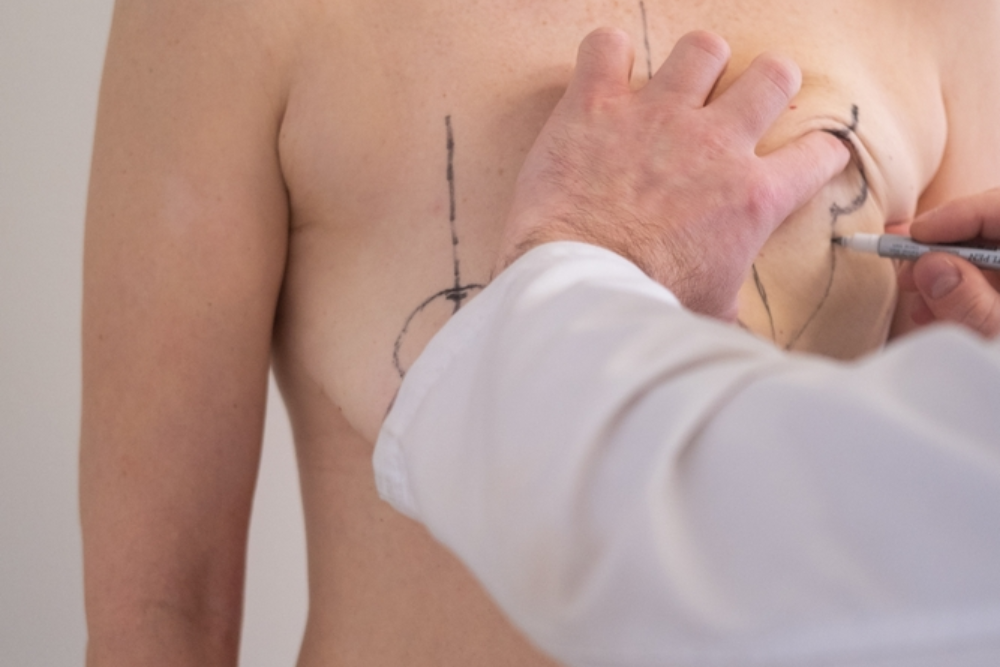
Evaluation lasts forty-five minutes. Dr Ben Naceur Radhi analyzes the thorax to distinguish true gynecomastia from pseudogynecomastia.
• Breast consistency: fatty, glandular, or mixed
• Volume of the palpable mammary gland
• Degree of skin excess and skin elastic quality
• Presence of inter-side asymmetry
• State of the nipple and areola
Standardized photographs are taken. The operative plan defines the technique according to the fatty or glandular predominance.
Dr Ben Naceur Radhi adapts the technique to the type of gynecomastia.
• Liposuction: Aspiration of adipose tissue through micro-incisions
• Technique: Classic or assisted liposuction, depending on density
• Result: Harmonious reduction through skin retraction
• Liposuction: Preliminary reduction of the fatty component
• Incision: A lower hemi-areolar incision, which is well-hidden
• Resection: Excision of the sub-mammary glandular plaque
• Closure: Resorbable sutures and compression
• Technique: Associated skin resection with areolar transposition
• Incision: Peri-areolar, with or without a horizontal resection
General anesthesia is preferred for comfort. Local anesthesia with sedation is possible for mild cases. Duration is sixty to ninety minutes.
Liposuction incisions are tiny and hidden. The areolar incision is imperceptible from a distance. Techniques with skin resection leave more visible marks, but they are well-hidden. Social discretion is rapid, as compression garments conceal the results during the first phase.
Gynecomastia treatment carries specific risks.
• Retro-areolar hematoma, sometimes requiring evacuation
• Prolonged seroma requiring punctures
• Areolar necrosis due to vascular impairment
• Skin depression due to excessive liposuction
• Abnormal cicatricial retraction
• Residual asymmetry
• Glandular recurrence if a persistent hormonal cause exists
• Skin irregularity from uneven liposuction
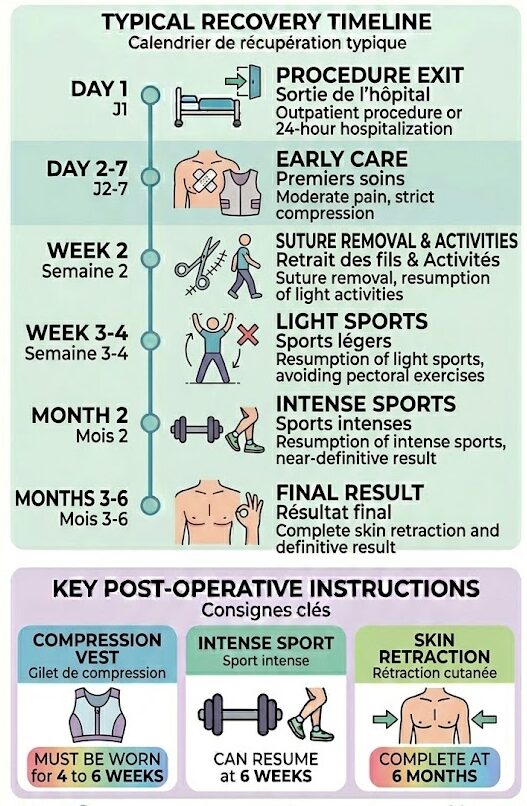
Outpatient procedure or twenty-four hour hospitalization
Moderate pain, strict compression
Suture removal, resumption of light activities. Resumption of light sports, avoiding pectoral exercises
Resumption of intense sports, near-definitive result
Complete skin retraction and definitive result
Gynecomastia treatment offers definitive results once the underlying cause is treated. The excised gland does not regrow. Patient satisfaction is very high. Men report liberation from major social discomfort, allowing them to resume sports and beach activities without anxiety.
Dr Ben Naceur Radhi has developed specific expertise in male breast surgery. His training in mini-invasive techniques allows him to obtain discreet results.
• Mastery of the distinction between fatty and glandular types
• Predominant use of liposuction with mini-invasive techniques
• Preservation of areolar vascularization
• A personalized approach according to the clinical stage
Gynecomastia treatment in Tunisia is a male aesthetic breast surgery offering transformative results. Dr Ben Naceur Radhi proposes adapted techniques for each type of gynecomastia. Men can regain a harmonious, masculine thorax and restored social confidence.
Discomfort is moderate in the first days, dominated by a sensation of tension. Prescribed analgesics ensure sufficient comfort.
Light sport can be resumed at three weeks. Exercises involving the pectorals and contact sports should be avoided for six weeks.
Yes, if a persistent hormonal cause exists or with major weight gain. A thorough pre-treatment etiological workup minimizes this risk.
Liposuction incisions are invisible. The areolar incision is discreet. Techniques with skin resection leave more visible marks, but they are well-hidden.
No, glandular resection does not modify the exceptional risk of male breast cancer.
A procedure to rebuild the breast after mastectomy or trauma, restoring body contour.

A procedure to reduce breast volume, improving physical comfort and body balance.

Surgery to correct sagging breasts and restore their position and firmness.
We place experience, medical rigor, and technical precision at the service of safe and personalized care.

