

A breast lift, or mastopexy, corrects sagging breasts by repositioning the nipple-areola complex and reshaping the gland. It restores a youthful, elevated breast contour after pregnancy, weight loss, or aging.
Dr. Ben Naceur Radhi applies advanced mastopexy techniques tailored to each degree of ptosis, ensuring natural, harmonious, and long-lasting results. The procedure can be performed alone or combined with implants for added volume.
There are many different types of cardiomyopathy caused by a range of factors, from coronary heart disease to certain drugs. These can all lead to an irregular heartbeat, heart failure, a heart valve problem, or other complications.
If you have known coronary artery disease, your doctor might recommend the traditional approach because you can also receive treatment during the procedure. Your doctor should give you instructions about how to prepare for CT.

Breast ptosis, or breast sagging, affects the majority of women after pregnancy, breastfeeding, or menopause. This soft tissue descent alters the silhouette and creates aesthetic discomfort. A breast lift in Tunisia offers definitive correction through nipple-areola complex repositioning and glandular remodeling. Dr Ben Naceur Radhi masters mastopexy techniques ensuring raised, harmonious breasts.
Motivations are mainly aesthetic, with a functional component. Moderate to severe ptosis is difficult to camouflage.
• Post-pregnancy breast ptosis with volume loss and sagging
• Involutive ptosis linked to aging and glandular atrophy
• Asymmetry caused by unequal ptosis between breasts
• Breast hypertrophy with associated ptosis requiring reduction
• An increased areola-to-breast ratio
The ideal candidate presents stable ptosis with sufficient skin quality. Pregnancy and breastfeeding should be terminated. Typical age ranges from thirty to fifty-five years.
• Absence of a pregnancy project within the next twelve months
• Stable body weight for six months prior
• Sufficiently elastic skin to maintain the elevation
• Understanding that the breast volume may slightly decrease
• Realistic motivation regarding the necessary scars
Dr Ben Naceur Radhi evaluates the degree of ptosis according to the Regnault classification, skin quality, and residual glandular volume.
Evaluation lasts sixty minutes. Dr Ben Naceur Radhi analyzes the bust to plan a harmonious elevation.
• Degree of ptosis: light, moderate, or severe
• Skin elastic quality and presence of stretch marks
• Current and desired position of the nipple-areola complex
• Residual glandular volume and possible indication for association
• Inter-breast symmetry
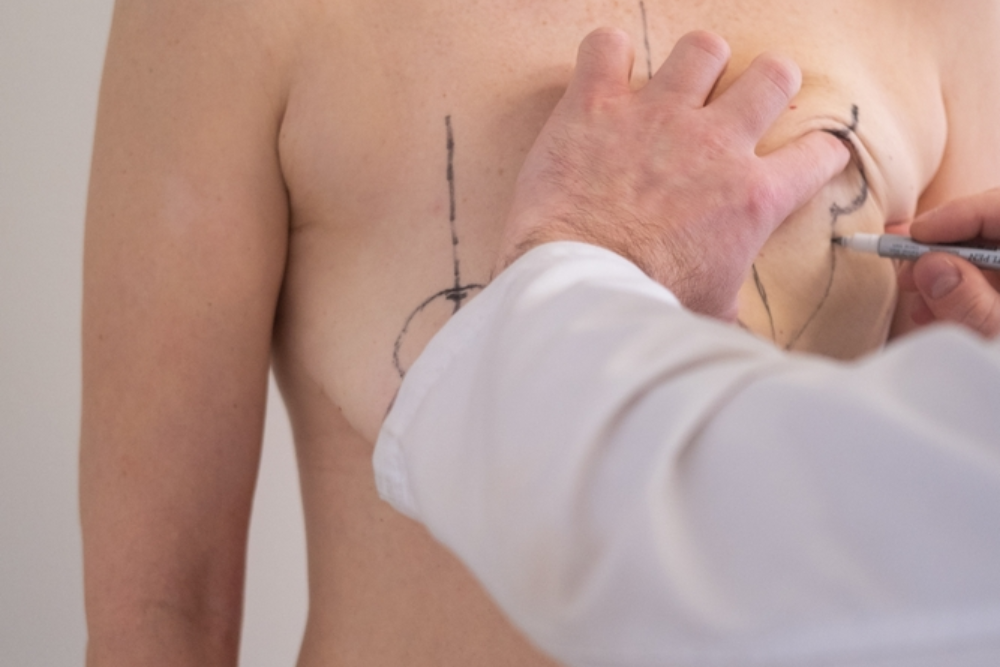
Standardized photographs are taken. Manual simulation by elevating the soft tissue helps appreciate the potential result. The operative plan defines the technique according to the degree of ptosis.
Dr Ben Naceur Radhi adapts the technique to the degree of ptosis and patient wishes.
• Incision: Vertical, from the areola border to the sub-mammary fold
• Resection: Excision of a vertical ellipse of skin and glandular remodeling
• Suspension: Fixation of the parenchyma to the pectoral fascia
• Transposition: Elevation of the nipple-areola complex
• Closure: Layered with resorbable sutures
• Incision: A vertical incision completed by a horizontal one in the sub-mammary fold
• Indication: Severe ptosis or associated hypertrophy
• Resection: Anchor-style skin excision and extended remodeling
• Closure: Inverted T with deep support points
• Indication: Ptosis with hypotrophy or a desire for more volume
• Technique: Dual plane with simultaneous mastopexy
General anesthesia is systematic. Duration is two to three hours, depending on complexity and association.
The vertical scar is limited to the breast’s lower pole. The inverted T technique adds a horizontal scar hidden in the sub-mammary fold. Cicatricial quality depends on a tension-free closure. Social discretion is rapid, as a support bra conceals the scars during the maturation phase.
A breast lift carries specific risks linked to the remodeling.
• Hematoma requiring evacuation
• Prolonged seroma requiring punctures
• Rare necrosis of the nipple-areola complex
• Border necrosis due to tension
• Recurrence of ptosis due to insufficient support
• Height or shape asymmetry
• Hypertrophic scars or dehiscence
• Loss of nipple sensitivity, which is frequent and often temporary
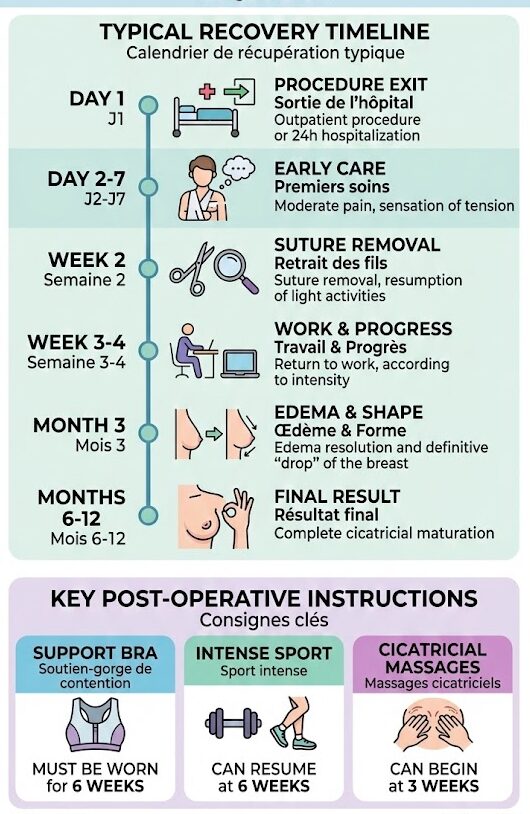
Outpatient procedure or twenty-four hour hospitalization
Moderate pain, sensation of tension
Suture removal, resumption of light activities
Return to work, according to intensity
Edema resolution and definitive “drop” of the breast
Complete cicatricial maturation
A breast lift offers immediate, lasting results. The elevation is visible from the moment of awakening. The definitive shape emerges after the three-month physiological “drop.” Patients report a major improvement in their silhouette.
Dr Ben Naceur Radhi has developed specific expertise in breast lifting. His training in glandular suspension techniques allows him to obtain durable results.
• Mastery of vertical and inverted T techniques according to the indication
• Glandular suspension to the fascia for enhanced durability
• Harmonious prosthetic association, if indicated
• A conservative tissue approach that preserves vascularization
A breast lift in Tunisia is an aesthetic breast surgery offering transformative results. Dr Ben Naceur Radhi proposes modern techniques combining durable elevation and aesthetic harmony. Patients regain raised, proportionate, and harmonious breasts.
Discomfort is moderate. A sensation of tension and compression dominates in the early days. Prescribed analgesics ensure sufficient comfort.
Return is possible at ten to fourteen days for sedentary activities. Physical employment may require three to four weeks.
Yes, generally. The glandular parenchyma and ducts are conserved, which allows for breastfeeding, although milk production may be decreased.
Results are long-lasting, typically ten to fifteen years, depending on skin quality. Gravity continues to act. A new pregnancy or weight gain may accelerate a recurrence of ptosis.
Not systematically. An association is indicated in cases of associated hypotrophy or a desire for more volume. Dr Ben Naceur Radhi advises based on morphological analysis.
The scars are situated on the lower pole of the breast and are concealable by a bra. They fade progressively over twelve to eighteen months.
A procedure to rebuild the breast after mastectomy or trauma, restoring body contour.

A procedure to reduce breast volume, improving physical comfort and body balance.

A procedure to increase breast volume using implants or fat transfer.
We place experience, medical rigor, and technical precision at the service of safe and personalized care.

